Zero-G Alpha 5.4.5 is live.
Since January you have been flying over planets. Now you can look at what you are flying over.
Alpha 5.4.5 replaces the old quadrant minimap with a real terrain map, upgrades the surveying minigame for finding deposits into a tactical challenge, and puts a new consumable into the economy. It is the biggest single change to the surface layer we have shipped, and it is the first step of a much longer road — more on that at the end.
The map
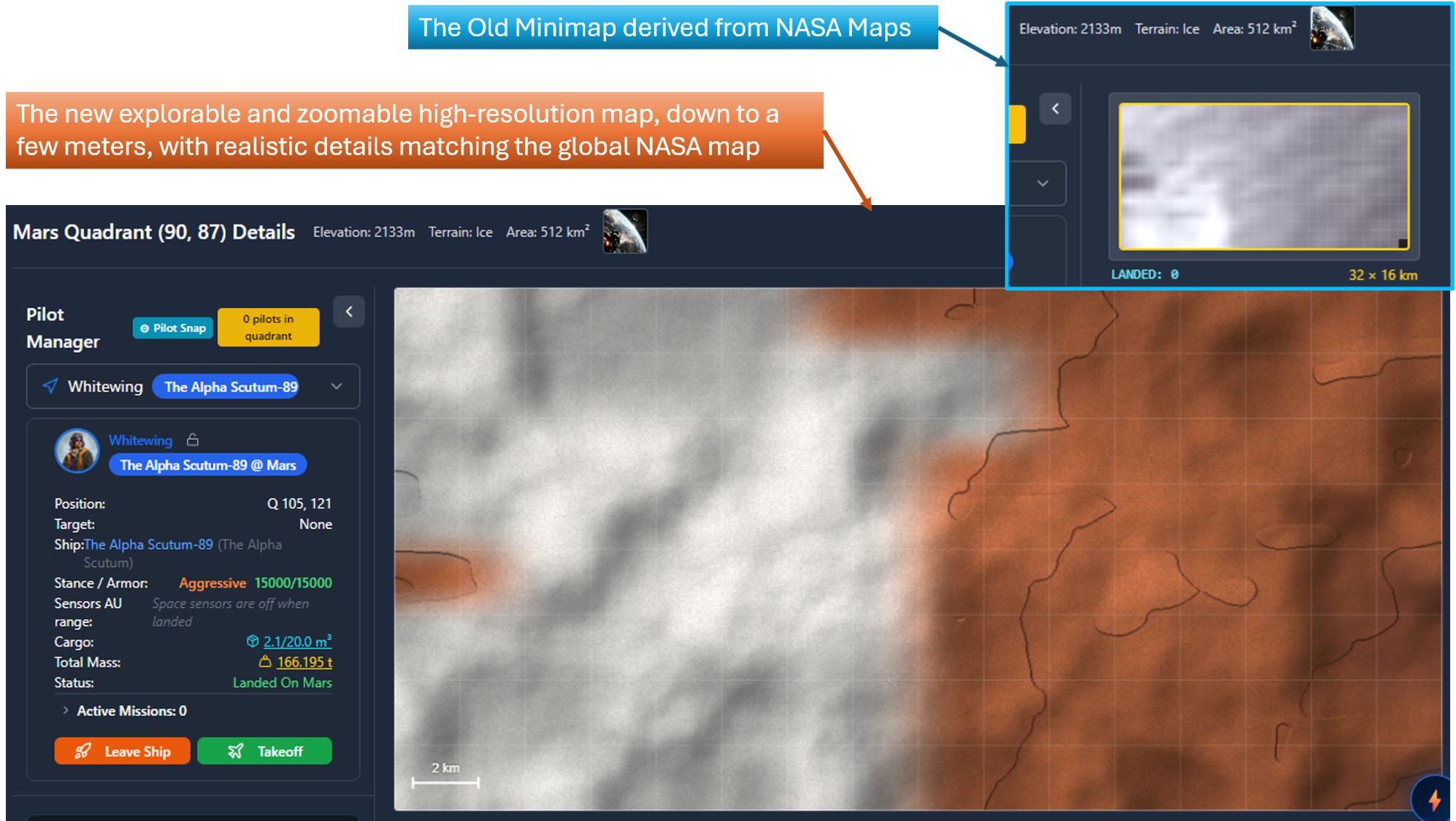
Scan a quadrant fully and the minimap is gone. In its place is a large terrain map you can zoom into, down to a few metres.
Same quadrant, same NASA elevation data underneath. A quadrant is 32 × 16 km — 512 km² — and until this release you saw all of it as a single blurred thumbnail.
The new Scan Local Map button resolves more detail wherever you are looking, at any zoom, without loading the whole quadrant. That is what makes the fine zoom levels affordable in a browser tab.
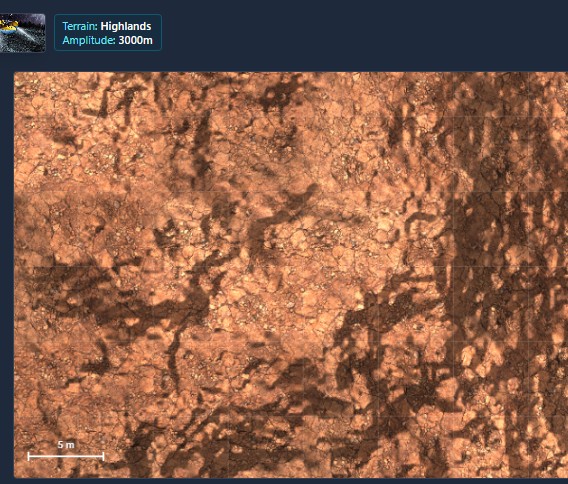
Zoom in far enough and this is what the ground looks like:
That scale bar says 5 metres.
Being straight with you: the tiling and the number of terrain types are deliberately limited right now, and if you fly around a lot you will see the same textures repeat. The engine underneath is the part we spent the time on. New terrain types and better tiling are cheap to add from here; the generator was not.
Your ship, actual size
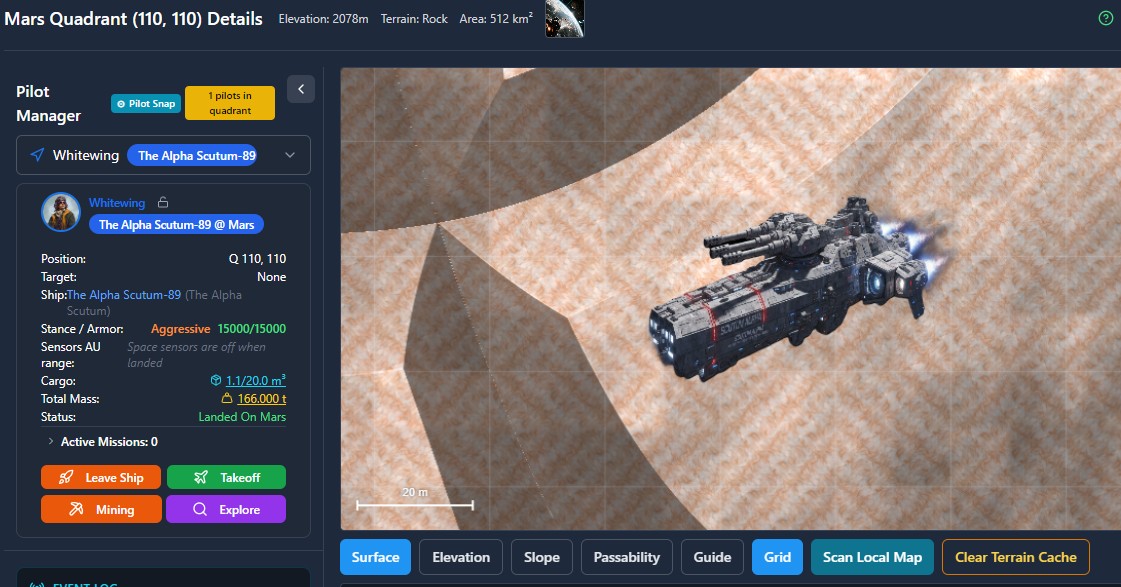
Land, zoom to maximum, hit Scan Local Map.
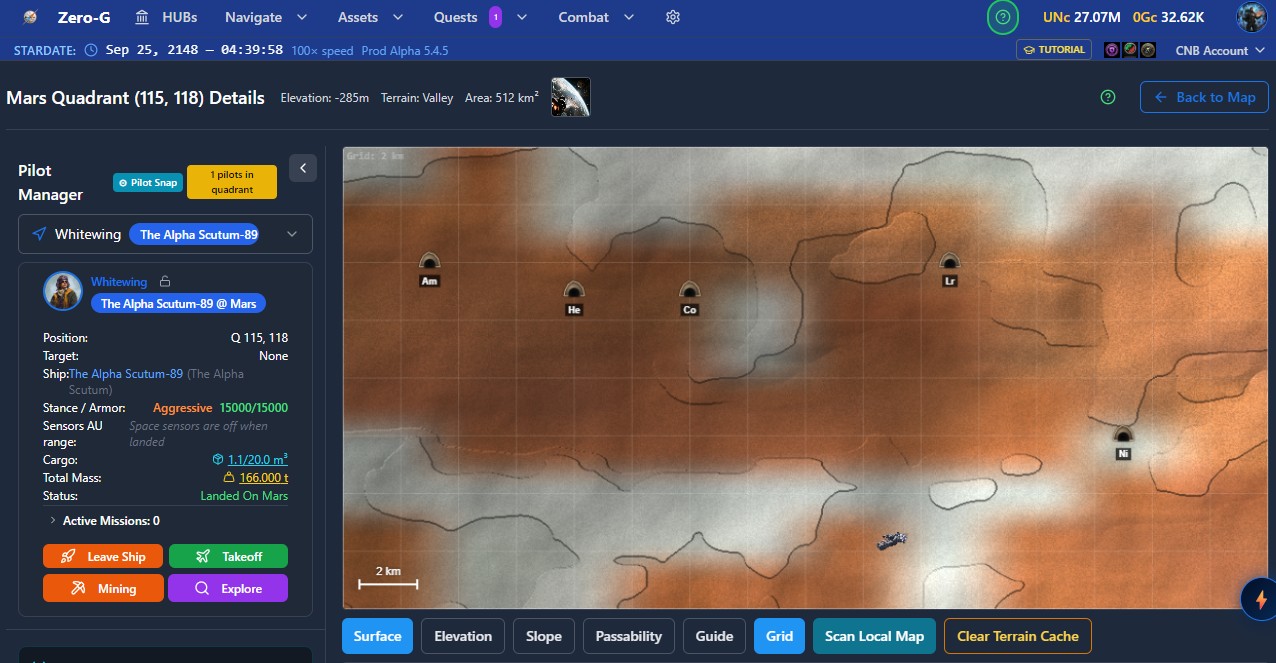
That is the Alpha Scutum-89 sitting on Mars at its real size against the real surface. Scale bar: 20 metres.
We have wanted this shot since the first prototype.
Surveying — the Explore button
Deposit-finding has moved onto the terrain map, and it is now something you play rather than something you wait for.
How it works:
- Carry a Basic or Advanced Terrain Probe in your cargo. Select it, double-click a point on the map, and the probe deploys. It is consumed on deployment.
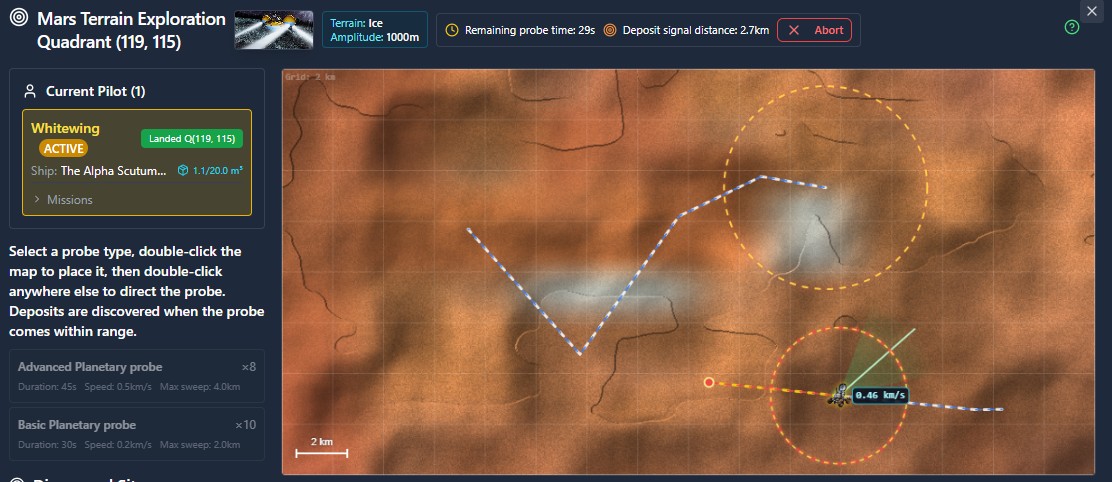
- Double-click anywhere else and the probe drives there, scanning as it goes. A yellow or red circle means a deposit is in range — shrink the circle to pin it down, exactly as before.
- Probe speed depends on the slope. Route planning before you deploy genuinely matters now; a straight line across a ridge can cost you the whole run.
- Sweep range depends on the probe's energy and on the terrain. Look at Amplitude, shown next to the terrain type at the top of the exploration page. Higher amplitude is harder to scan through: Ice reads 1000 m, Highlands reads 3000 m. The same probe covers far less ground in the highlands.
The clock in the screenshot above says 29 seconds remaining and a deposit signal 2.7 km away. That is the whole game in one line.
Find them and they stay found:
Americium, helium, cobalt, lawrencium, nickel — labelled by element symbol on the map, in a valley 285 m below datum.
The probe economy
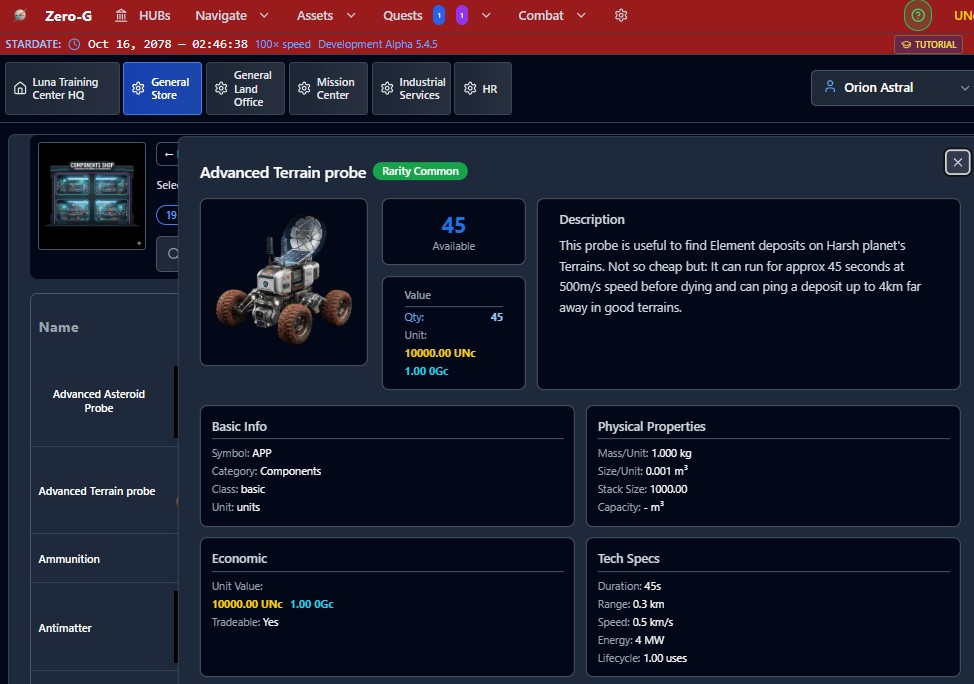
The two probes are worth a paragraph on their own, because they are a new production niche.
Basic Terrain Probe: 30 s 0.2 km/s 2.0 km
Advanced Terrain Probe: 45 s 0.5 km/s 4.0 km
Both sell at HQs in limited quantities, and both blueprints are available. Production cost is very low. If you have Synthesis skills, you can build them in bulk for a fraction of the shop price and sell them at HQs or on the Auction House.
If you have been looking for something to make that people will actually buy every week, this is it.
Everything else in 5.4.5
Improvements
- Laser power and range bonuses are now visible in combat.
- Better pilot selection in the Pilot Manager.
- Full pilot stats are visible in packages and offers before you acquire them.
- Auction House live offers show the Buy Now price and the minimum bid.
Fixed
- Moon mining and prospecting missions paying too little.
- Ships stuck in combat status.
- Refining failing on some element sub-categories.
- Wrong cargo capacity displayed.
- Missions referencing terrain that did not exist.
- New players not being created correctly.
- Account-wide refining bonuses were being ignored. Refining is now much faster even with a small bonus. If refining has felt slow to you for months, it was not you.
Where this goes
This is the part we usually keep out of the public posts, so it stays here.
The terrain engine is not the feature. It is the floor that other features have to stand on. With it in place, the road ahead is:
Manual navigation and landing on the surface, instead of arriving by menu.
Vehicles that drive on the terrain you can now see.
First-person exploration on foot.
Points of interest worth travelling to — alien structures, wrecks, artifacts.
Eventually, player installations and colonies on ground you surveyed yourself.
None of that is in 5.4.5. Nothing in the list above is playable today. We are telling you the direction because you are the people who have been here long enough to care about the direction — and because the order matters: none of it was possible last month, and all of it is possible now.
New tutorial video
A full walkthrough of terrain exploration and finding ore deposits, chapter by chapter:
Exploration Tutorial
If you only watch one section, make it the probe deployment.
Zero-G in the press
Zero-G has a media patronage with Portal MMO, one of Poland's MMO sites. They have published three pieces on the game:
Zero-G is growing stronger — the browser hard sci-fi MMO is getting a new planet system and survey probes — a news piece on exactly the release you are reading about.
Zero-G in the Portal MMO game encyclopedia — the full database entry.
Zero-G HD gallery — 16 screenshots.
All three are in Polish. Your browser will translate them, and it is worth a look — it is the first time anyone has written about the game in a language none of us speak.
The Bulwark Call — closed
The first expedition gated on faction reputation ended on 29 August after eight days.
Twelve pilots enrolled. Three held the line all the way to a ranked finish:
- Pink Nyanko
- snowpepsi
- TerPen
Congratulations to all three, and thank you to everyone who flew the Ares Rampart line.
Twelve is a small number, and we knew it would be — the reputation gate was there to make the expedition mean something, and it did exactly what a gate does. The next one will be built on what we learned here.
The numbers
1,672 registered pilots · 18,269 missions flown.
👉 Join the Shard
📺 YouTube channel
👾 Zero-g Discord official server
📰 Press kit
Giuseppe & the Zero-G Team
HOLD THE LINE, PILOTS!