Where we were
Combat in Zero-G has always worked, in the sense that ships shot at each other and one of them won. But it was a solved problem. You brought a cutter, you pointed everything you had at the biggest threat, and you watched. Two pilots in the same battle were two people having separate fights in the same room.
Over the last month we rebuilt the foundations for something else. 5.5.3 gave every world its real gravity and made flying a skill rather than a procedure. 5.5.4 rebuilt the combat engine itself — longer fights, much shorter weapon ranges, aliens that predict where you are going instead of where you are. Both were groundwork.
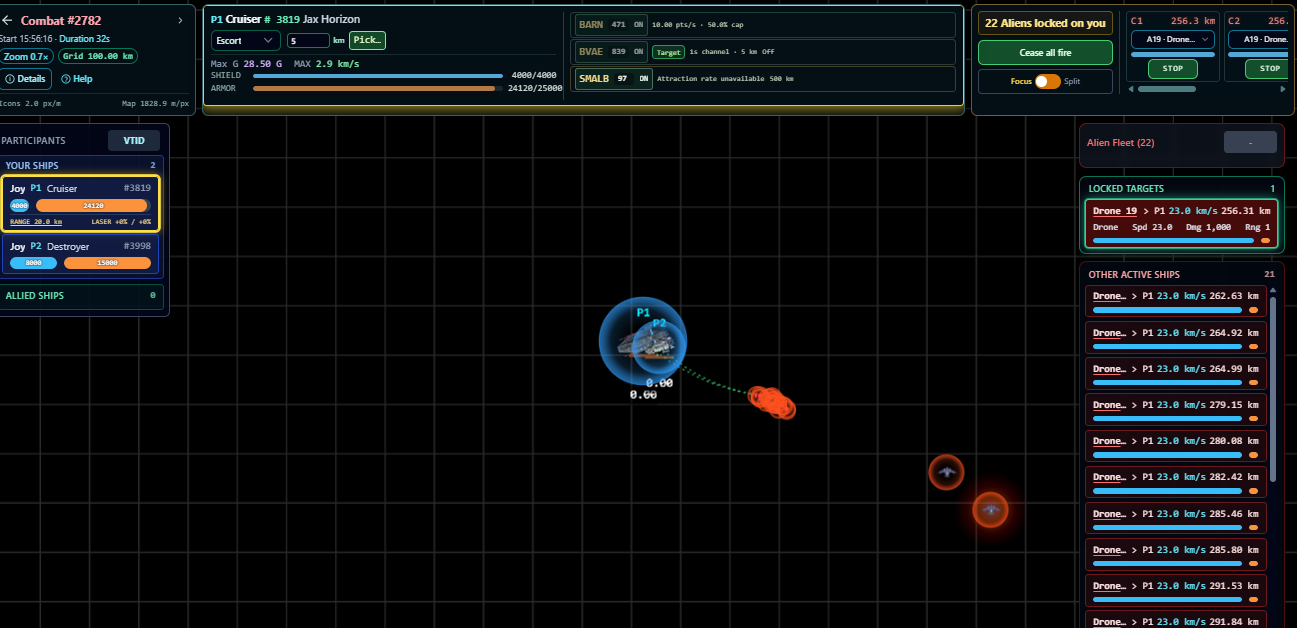
5.6.0 is what they were groundwork for. The combat server now handles hundreds of ships at once, fluidly. And the enemy has changed in a way that makes your old answer the wrong one.
The swarm
Vatican Intel has confirmed a new alien vessel in the inner system. Small, almost certainly unmanned, and appearing in numbers that are climbing week by week. We are calling it the Minor Stinger.
Individually it is nothing — fast, lightly built, one good hit and it is gone. It also carries a cannon far heavier than anything that size has any business carrying, and it never arrives alone.
This is the first enemy in Zero-G that cannot be beaten by doing the obvious thing well. It has to be answered with a different shape of attention.
So your guns learned to split
The combat card now lets you focus every cannon on a single target, or split fire and let each cannon pick its own. You can also assign targets by hand, cannon by cannon, and switch any of them off. Double-clicking an alien card throws everything you have at it instantly.
Both modes are correct — against a frigate, focus. Against a swarm, split. Knowing which fight you are in is now a skill.
The combat simulator has been extended to match: you can preset your ships' stances and escort assignments before a scenario runs, so tactics can be tested rather than guessed at.
The idea this release is named after
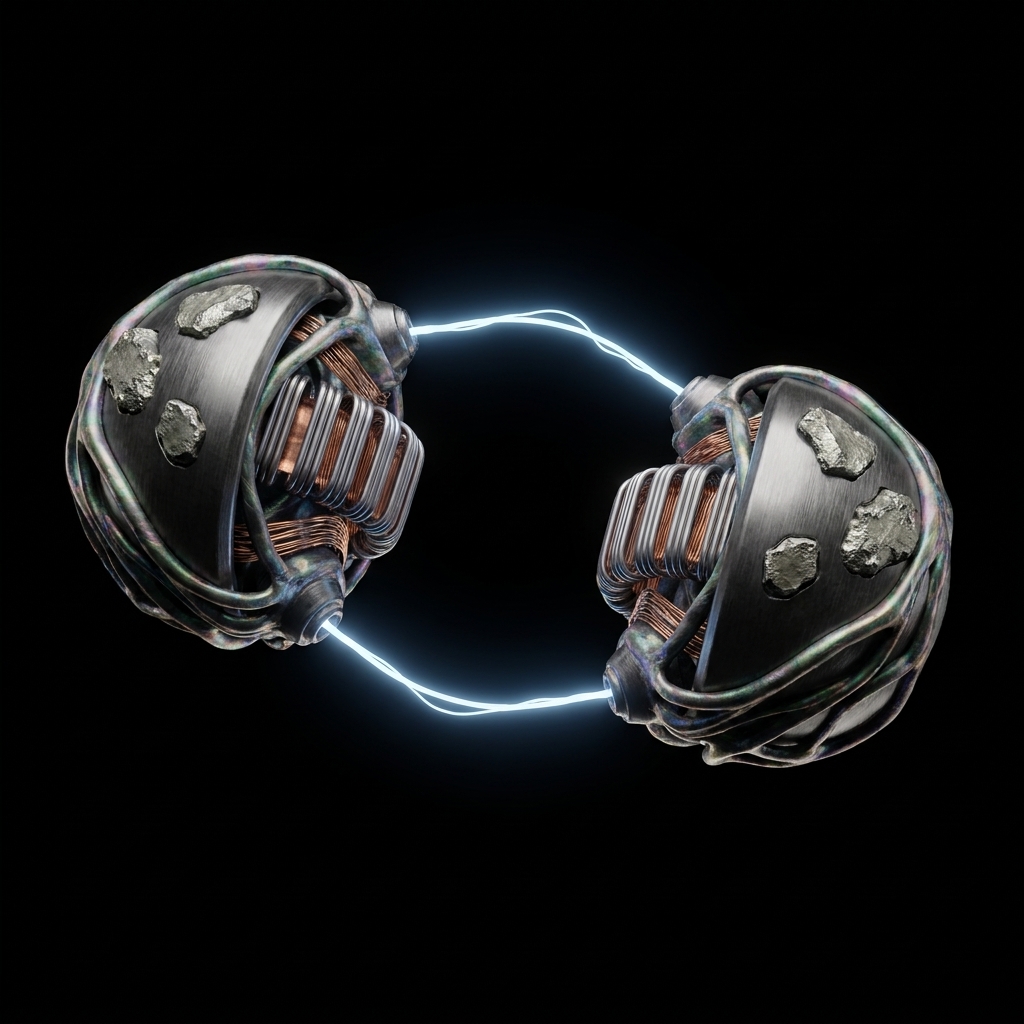
The Vatican Research Centre in Greenland has been combining alien scrap with rare materials, and it has produced something genuinely new: the Vinculum Aegidis. A nanobot that opens a shield channel between two ships.
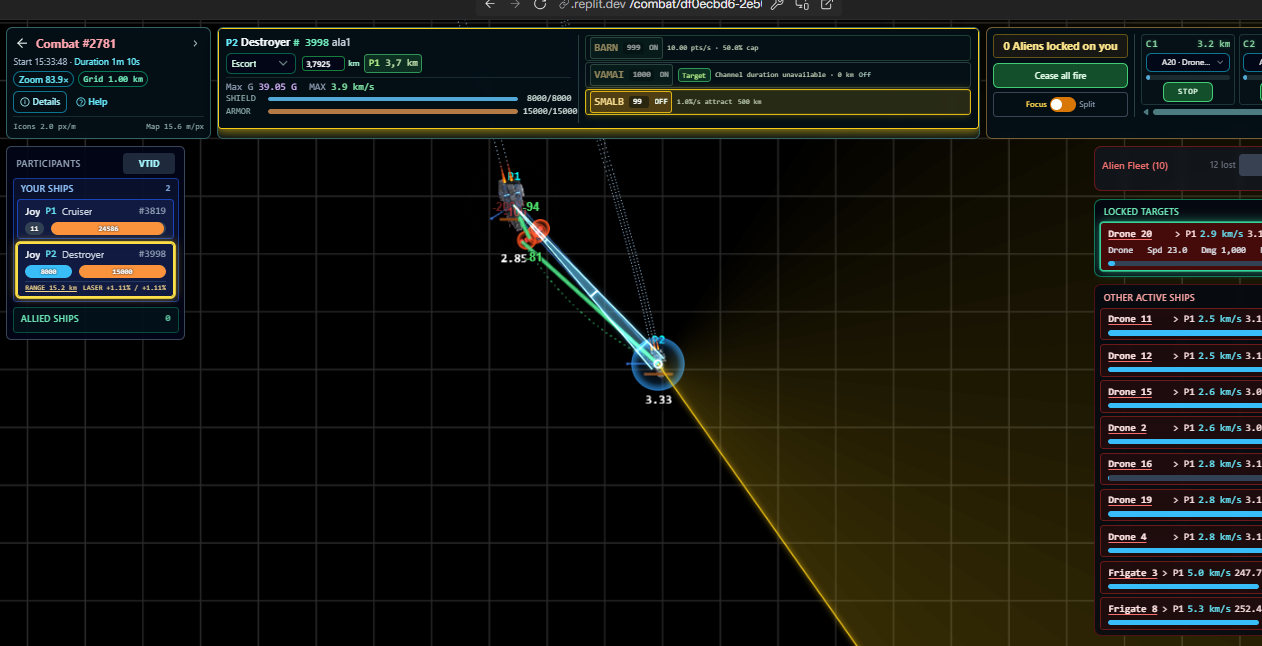
When the protected ship takes a hit, the damage its shields should have absorbed is transferred instead to the ship at the other end of the channel — provided that ship has the shields to take it. Two ships channelling each other simply share one pool of shielding between them.
It is expensive in the way that matters: the nanobots burn at one unit per second, and the range is short. But it changes what a fleet is. For the first time in Zero-G, another pilot can decide to absorb something aimed at you.
| Item | Duration | Range | Availability |
|---|---|---|---|
| Vinculum Aegidis Minus | 1 second per unit | 5 km | Main HQ stores, and craftable from its blueprint |
| Vinculum Aegidis Maius | 5 seconds per unit | 20 km | Mission and expedition rewards, or the Combat Pack offer |
A ship built for this war
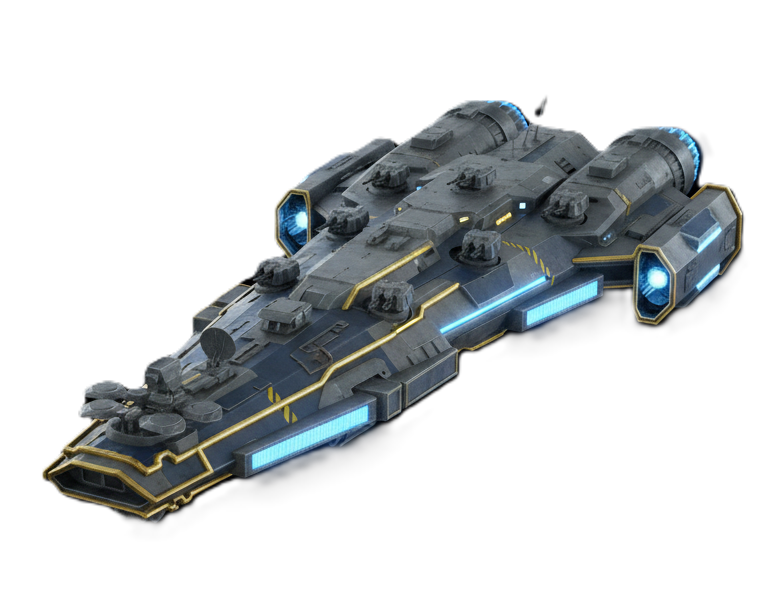
As soon as the drone threat was understood, a new hull was commissioned. The Velite destroyer carries six cannons — eight on the premium Velite Custos — for more than fifty per cent more firepower than a standard cutter, and it is markedly faster and more agile.
The trade is deliberate and it is sharp. Its weapons reach 6 km, or 10 km on the Custos, against the cutter's 15. Its armour is thin. Its shields are excellent.
That makes it close to ideal against drones and scouts, poor against frigates and anything larger, and — because of those shields — an unusually good ship to hold a channel open from. The hull that kills swarms is also the hull that keeps someone else breathing.
Something nobody has solved yet
Planetary PSAR arrays and ship sensors have both been upgraded. Alien fleets can now be tracked properly, and their routes are drawn on your display when they pass within sensor range.
The sensors also do something we did not entirely expect. They read the fleet's emissions and return a Trait — a signature string, consistent and repeatable, that looks like this:
S6C251A1D12466
The Vatican is working on it. So far, so is everyone else.
We know what it encodes. We are not going to tell you.
What we will say is this: the string is not random, every character is doing something, and the information in it is about the fleet you are looking at. A pilot who learns to read a Trait will know what is coming before it arrives — composition, strength, what is worth engaging and what is worth running from.
This one is for the community, deliberately. The Trait is visible in the combat simulator for a given scenario, which means it can be studied safely, as many times as you like, at no risk.
Post the Traits you see, alongside what the fleet actually turned out to contain, in #hints-and-tips on Discord. One pilot will not crack this. Thirty pilots comparing notes might, and quickly. We will release further hints over time — but we would rather you got there first.
The time artifacts
Among the salvage, something stranger: the Chronica. Alien devices that appear to manipulate time directly, recovered rarely and usually as mission or expedition rewards.
- Clepsidra Minor — extends a mission by 30 minutes, or cuts 30% from a crafting job's remaining time.
- Clepsidra Maior — extends a mission by 60 minutes, or cuts 60% from the remaining time.
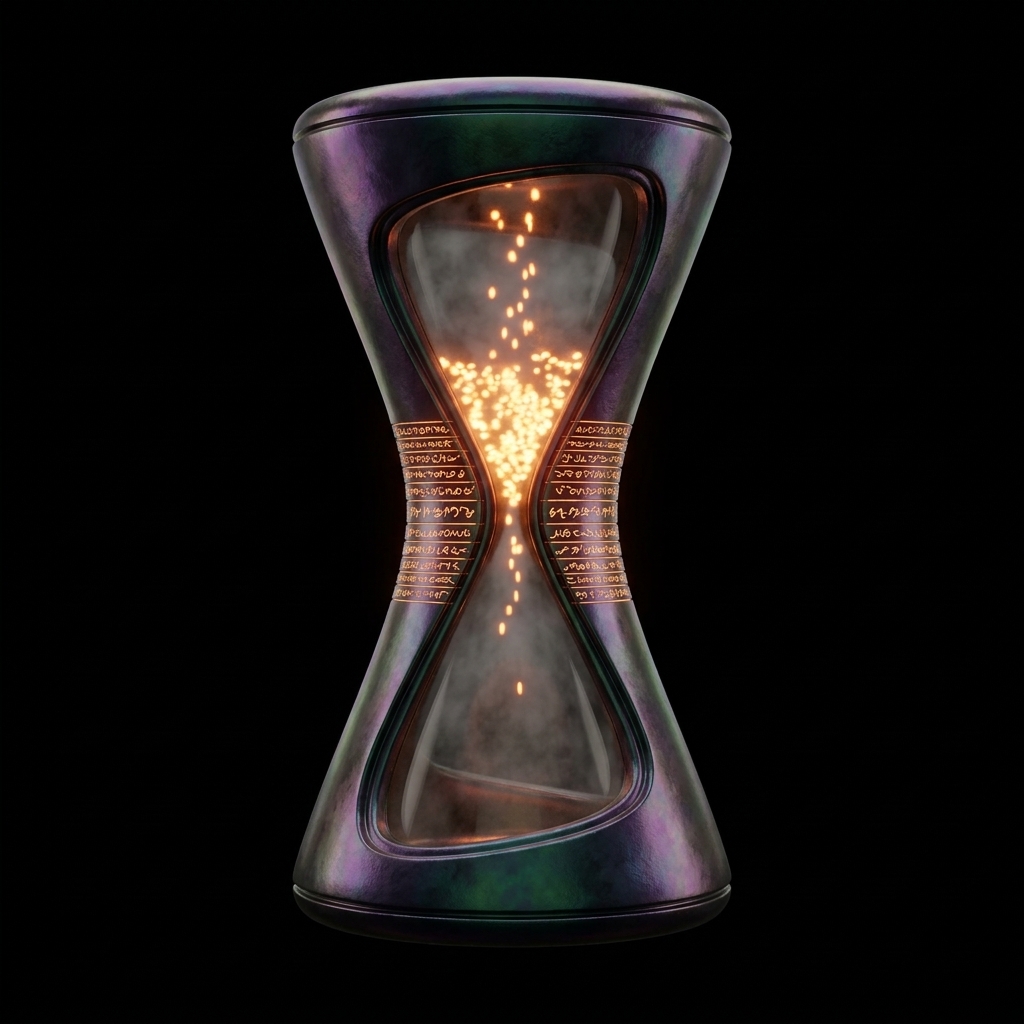
Carry one in your hold and an Extend time button appears on the active mission page. For crafting, click the job row in your plant to open the panel.
Bulla Animarum
The next monthly expedition opens on Wednesday, and it is built on everything above. New standard and premium destroyers, new items, and Chronica rewards at both standard and golden tiers. A Golden Pass goes on sale when the expedition starts, carrying significant combat bonuses alongside the premium hull and special items.
Three new combat mission types arrive with it, and two of them are the point of this entire release:
- Absorb — take armour damage and survive the battle.
- Channel — pull shield hits onto yourself to protect someone else.
- Beacon — draw alien fire onto your ship using Alien Beacons.
Standard combat missions can now also require specific alien classes to be destroyed — a Ghost Finder scout, a Salamander frigate, a Minor Stinger drone.
Read this before you enrol. A Channel mission requires somebody on the other end of the channel. You cannot complete it alone, and no amount of skill substitutes for a second pilot.
Bulla Animarum is, by construction, an expedition about flying with other people. Find a venture-mate, agree who takes the hits, and turn up at the same time.
Where we are going
The honest version: the inner system is getting more dangerous, and that is the direction we have chosen.
The drone swarms are not a one-off encounter type. Minor Stinger is a name with room in it. The Trait system exists because fleets are going to become varied enough that knowing what you are facing will matter more than knowing how to shoot. And the shield channel is the first of a class of mechanics that only function between two players — the beginning of a game where a fleet is a group of people rather than a group of ships.
Everything we have shipped since September points the same way. Landing became something you fly. Prices became something your location decides. Now survival is becoming something another pilot can hand you.
Zero-G is a 1:1 scale Solar System that has not been reset since January 2026, and we update it every two to three weeks. It is free, it runs in a browser, and nothing above requires an installation.